• Home
  • Who
    • #
    • About Us
      • Who We Are
      • Meet the Partners
      • Become A BRCA Partner
      • Join Our Email List
      • Our Green Pages Directory
  • What
    • #
    • Mission, Vision, and Goals
      • Stewardship Principles
      • Issues
      • Work Groups
      • Events
  • Where
    • #
    • Focus Area
      • Focus Area Map
      • Interactive Story Map
  • News
    • #
    • News
      • Events Calendar
      • BRCA News
      • Sign up for eNews
  • Resources
    • Video Library
    • Webinars and Presentations
    • Maps
    • All Resources
info@blueridgeconservation.org
Events
Blue Ridge Conservation AllianceBlue Ridge Conservation Alliance
  • Home
  • Who
    • OUR PARTNERS represent the most active conservation groups in the upper Shenandoah Valley
    • About Us
      • Who We Are
      • Meet the Partners
      • Become A BRCA Partner
      • Join Our Email List
      • Our Green Pages Directory
  • What
    • OUR MISSION is to preserve and protect the natural resources of the Blue Ridge
    • Mission, Vision, and Goals
      • Stewardship Principles
      • Issues
      • Work Groups
      • Events
  • Where
    • OUR FOCUS is the highly-threatened region from Shenandoah National Park to the Potomac River
    • Focus Area
      • Focus Area Map
      • Interactive Story Map
  • News
    • NEWS & UPDATES from our alliance and our partners.
    • News
      • Events Calendar
      • BRCA News
      • Sign up for eNews
  • Resources
    • Video Library
    • Webinars and Presentations
    • Maps
    • All Resources

News

They Came to Washington to Learn About Tiny Fish. Here’s Why.

Alliance Partners |

Sometimes little things can make a big difference.

Forage fish – like mullet, shad, herring, and sardines – although themselves tiny, are essential to the ocean’s entire food web. At the base of the food web are plankton. Forage fish eat plankton, and then larger animals eat forage fish. At some level, everything else basically depends upon the forage; think about bigger fish we like to eat like salmon, or wildlife that drive recreation and tourism such as dolphins, whales, and seabirds. Without forage fish, it all falls apart.

That explains why outdoors enthusiasts and wildlife advocates from around the country recently traveled to Washington, D.C.: to learn more about forage fish so they could serve as resources for their curious friends, colleagues, and lawmakers. Many of these individuals were anglers, some making a living off the water as fishing guides. Others recreate on and around the water.

“It’s vital for us to preserve our forage fish, for our sport fishing industry and a healthy marine environment.”

– Johnny Marquez, director of coastal programs for the Mississippi Wildlife Federation, a lifelong recreational angler.

“My big concern is to be a good steward of the food chain,” said David Baker Haire of the Georgia Wildlife Federation, a hunter and angler who has a background in zoology and previously served with the International Union for Conservation of Nature. “We need to find a way to address coastal resources, including forage fish.”
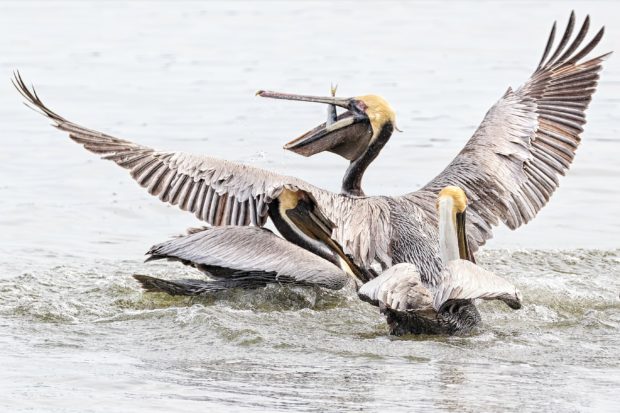
Brown pelicans. Credit: Kim Davidson

Reps. Debbie Dingell (D-MI) and Brian Mast (R-FL) recently introduced the Forage Fish Conservation Act, to improve our stewardship of the food chain. This legislation would make a number of changes to how forage fish are managed, including by ensuring that we have good science on how commercial fishing for a new forage fish  impacts existing fisheries, fishing communities, and the marine ecosystem prior to the fishery being authorized.

It’s not just coastal residents who are concerned.
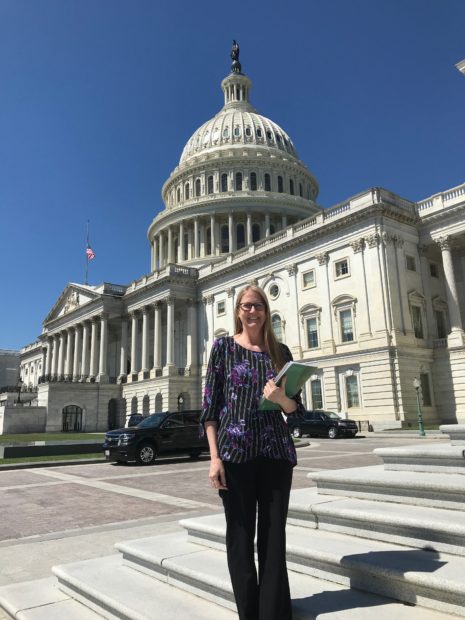
Julie Smith in front of the Capitol. Credit: Michael Happ / NWF

“When you take away pieces of the food chain, it affects everything from the ocean to the economy,” said Julie Smith, a Wisconsin-based wildlife photographer who grew up in a family that’s been in the boat industry for decades, helping launch the world-famous Sturgeon Bay Open Bass Tournament. “Today, I take pictures of birds who feed on forage fish all winter long, like pelicans and loons that return to Wisconsin after wintering in the Gulf of Mexico.”

“Without a bill like this, it’s like the game Whack-A-Mole,” said Marquez of the Mississippi Wildlife Federation, who is also president of FishHead Gear, a wholesale apparel provider. “Single species management creates that kind of environment. You clamp down on one species, but that causes overfishing for another. We’re trying to change that mindset when it comes to forage fish, at the bottom of the chain, which are fed on by almost everything. When too many forage fish are scooped up, we lose the recreational fishing opportunity for other species.”


The post They Came to Washington to Learn About Tiny Fish. Here’s Why. appeared first on The National Wildlife Federation Blog.

0

You also might be interested in

Enter PEC’s annual Virginia Piedmont photo contest now through Sept. 30

Enter PEC’s annual Virginia Piedmont photo contest now through Sept. 30

Aug 29, 2025

alling all professional and amateur photographers. Now through September 30,[...]

Bluebirds Welcome! Community Adds More Nest Boxes for Bluebird Families

Bluebirds Welcome! Community Adds More Nest Boxes for Bluebird Families

May 15, 2024

Volume 29 Issue 2, Spring 2024 by Frank Gardner and[...]

Friends of the Blue Ridge Mountains

Jefferson County Development Authority’s Meeting today (9/18/18) at 3:00 pm

Sep 18, 2018

Today is the Jefferson County Development Authority’s (JCDA) third and[...]

Alliance Partners

  • Appalachian Trail Conservancy
  • Blue Ridge Watershed Coalition
  • Changing Landscapes Initiative
  • Friends of the Blue Ridge Mountains
  • Goose Creek Association
  • Friends of the Shenandoah River
  • Land Trust of the Eastern Panhandle
  • Land Trust of Virginia
  • Loudoun Wildlife Conservancy
  • Piedmont Environmental Council
  • Potomac Appalachian Trail Club
  • The Downstream Project
  • Virginia Working Landscapes

Loudoun Wildlife Conservancy

  • Data Centers in the Town of Orange? Protecting Our Small-Town Character The Piedmont Environmental Council (PEC) is working closely with residents...
    Read more
  • Piedmont Mobility Alliance Convenes Summit to Advocate for Better Community Access to the Great Outdoors The Piedmont Mobility Alliance will convene the sixth annual Active...
    Read more
  • An Electric Super-Highway Through the Piedmont Joining the list of new energy and infrastructure proposals across...
    Read more
  • An Electric Super-Highway Through the Piedmont Joining the list of new energy and infrastructure proposals across...
    Read more
  • 2026 Work Days at JK Black Oak Wildlife Sanctuary Before getting started, Gerco briefs volunteers. Photo by SA Ferguson...
    Read more

Contact Us

We're currently offline. Send us an email and we'll get back to you, asap.

Join Us Today! Learn More

Contact Us

  • (540) 955-6066
  • info@blueridgeconservation.org
BRCA monthly e-Newsletter

E-NEWSLETTER

Our e-Newsletter will keep you in-the-know on regional conservation Action Events and News from our Partner Organizations).

Sign Up

SOCIALIZE

Follow us on social media

© 2026 · Blue Ridge Conservation Alliance • network website powered by The Downstream Project

Prev Next

Press Enter to search · Esc to close