Restore Half Your Lawn to Native to Save Us All
Volume 27 Issue 4, Fall 2022
by Sharon Plummer
This article’s headline may sound dramatic and exaggerated, but it is what I learned at a conservation talk recently. If we all pitched in to plant native plants and trees and reduce the size of our grass lawns, it could bring back the biodiversity that we have lost through our modern landscape and development practices.
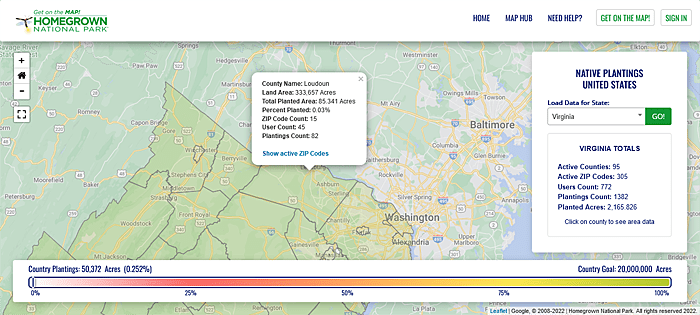
At this event I heard a presentation by Doug Tallamy, professor of entomology at the University of Delaware and author of Nature’s Best Hope. Tallamy outlines a plan of re-naturalizing 20 million acres in the United States. If we are able to work together to accomplish this feat, we can restore the rich, interconnected ecosystems that our country needs for humans and wildlife to thrive together. Tallamy’s Homegrown National Park program is an ambitious community environmental project that invites private landowners to enroll their land in the program and become part of the solution to the critical environmental problems facing humans and wildlife.
Tallamy has compiled compelling statistics — from his own studies and those of other organizations that helped — to calculate some quantitative goals that we can all work toward to help achieve this noble endeavor. He highlights many factors that define why we humans are dependent on the food web of nature. This is not just a project for nature hobbyists; everyone should be engaging in it regardless of political or cultural affiliation. Restoring our planet to a sustainable home for all inhabitants is something that we can do together if many people take small actions.
For sustainable biodiversity, we need a connected network of habitats. Tallamy started the concept of the Homegrown National Park to communicate that citizens can form a park-like patchwork of our properties. Only 5% of lands in the United States are preserved in parks, so the only way to accomplish our goal is to restore private lands in yards, airports, power-line corridors, and more. If we restore many smaller plots of land with native plants, we can build a web of habitat across the country that will sustain the diverse natural relationships humans and nature need to thrive.
There is a lot of interesting data to support Tallamy’s ideas and goals, so I highly recommend reading one of his books or watching his presentations online, where he elaborates on these topics with depth and eloquence.
Key Points
- 80% of all plants and 90% of all flowering plants are reliant upon pollinators.
- Insects are the base of the food web; it is believed that humans cannot exist without a functional food web.
- Throughout much of America, 14% of plant species make up 90% of the insect food. These are “keystone” species, a term emphasizing the importance of some plants that are critical to good ecosystems.
- If we added up all the powerline rights-of-way, golf courses, airports, and other private lands, it comes to 599 million acres. Restoring just a percentage of that could have amazing results for our country’s biodiversity and biomass.
- Tallamy restored his own 10-acre property with key native plants and trees and has created a successful habitat where 1,028 moth species and 59 bird species breed successfully.
- Non-native ornamental plants support 29 times less animal diversity than do native plants. If we buy more native plants and stop buying invasive non-natives such as Bradford Pears and non-native honeysuckles, then large nurseries and stores will be forced to provide more natives.
- If landowners could restore 50% of their lawn to native plants and trees, we could make significant progress in restoring our nation’s biodiversity and ability to support human life and wildlife.
- Even if you have only a small yard, planting a few keystone species will have a positive impact.
- Reduce or eliminate chemical pesticide use because its impacts are so negative to our environment.
- Visit the Homegrown National Park website to find information about keystone species by area within the US. Some common ones listed for Eastern temperate forests are oaks, poplars, cherries, Joe Pye Weed, asters, and Skunk Cabbage.