A Work in Progress: Meadow Restoration at JK Black Oak
Volume 30 Issue 1, Winter 2025
by Sheila Ferguson and Gerco Hoogeweg

Volunteers remove invasives at the southwestern edge of the meadow. Photo by S.A. Ferguosn
When you think of wildlife habitat, meadows may not be your first thought, but they provide cover and food for many birds, insects, and other wildlife. Some bird species such as Bobolinks, Eastern Meadowlarks, and Grasshopper Sparrows rely on meadows and grasslands for nesting sites and rearing their young.
Meadows are open areas dominated by native grasses and wildflowers that are free of woody vegetation. On the East Coast, meadows are always in transition. Without intervention, nature will slowly convert them to forests through the process of natural succession. Keeping a meadow open requires active management such as burning, mowing, or grazing by livestock. They are among the most diverse plant communities in our region, but they are becoming less common due to development, invasive plants, and management policies that eliminate or adversely impact meadows.

A volunteer cuts back invasive Autumn Olive at the meadow’s edge. Photo by S.A. Ferguson
This is bad news not only for wildlife, but for humans, too. Along with their natural beauty, meadows benefit people by providing ecosystem services including stormwater infiltration and carbon capture. Research has shown that soils in meadows with a variety of plant species store much more carbon than soils in weedy areas and those with low plant diversity.
At JK Black Oak Wildlife Sanctuary, meadows are found on both the east and west sides of the property. In December 2023, with funding from Microsoft in collaboration with the Society for Ecological Restoration’s Standards-based Restoration in Action program, we began the long process of restoring the meadow on the west side of the property. Bringing the meadow back to a biodiverse area dominated by native herbaceous species will require addressing multiple issues.
Since Loudoun Wildlife purchased the property in 2020, the southwestern end of this meadow has been overgrown with invasive trees and shrubs that are also encroaching on the rest of the meadow from all sides. At the top of the list of problems is Autumn Olive (Elaeagnus umbellata), which offers a double whammy. It rapidly grows into a very large shrub that shades out anything beneath it, and it alters the local nitrogen cycle, making it hostile to native plants.
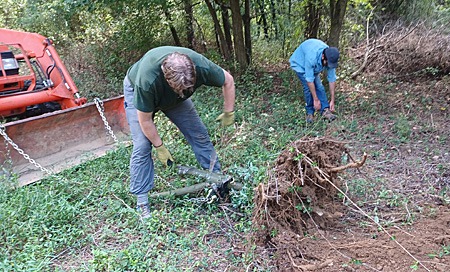
The tractor is used to pull Autumn Olive stumps. Photo by S.A. Ferguson
Unfortunately, some native trees and shrubs also need to be removed or controlled to prevent the meadow from eventually turning into forest. American Persimmon (Diospyros virginiana) has been the most troublesome of the native woodies to control. It sends out underground runners from which new trees will sprout if not removed. Blackberry bushes are also making inroads on the meadow, with large tangles on the sides and smaller sprigs throughout the meadow as birds eat the fruit and drop the seeds in their scat. If left uncontrolled, they form thick, dense thickets up to 10 feet in height.
Controlling both the invasive and native woodies involves cutting down the larger ones and treating the stumps with herbicide to prevent regrowth, or pulling out each stump using the tractor. The smaller woodies and blackberry thickets are controlled by mowing with a large rotary cutter. We are fortunate to have two rotary cutters to use: one donated by Loudoun Wildlife member Pat Whittle, and one purchased using grant funds.
The two species of goldenrod growing in the meadow are also a problem. How can such beautiful natives be a problem? It’s because they have formed dense colonies that prevent other natives from growing, which results in lower biodiversity. The best means of control for such a large area is to mow the goldenrod before it sets seed, which should also reduce the vigor of the plants.

Volunteers install native plants in the west meadow. Photo by S.A. Ferguson
Starting in the fall of 2024, 50 percent of the meadow is being mowed annually (alternating the mowed areas). Mowing even just a part of the meadow helps reduce the impact on wildlife, including providing habitat for overwintering insects, by slowing the natural forestation process. In addition to controlling woodies and goldenrod, regular mowing of the meadow should contribute to increased plant diversity. We saw this happen in the southwestern part of the meadow after it was mowed in May 2024 to create the new planting area. In the mowed area, native herbaceous species emerged, including American Pennyroyal (Hedeoma pulegioides), which had not previously been found anywhere at JK Black Oak.
Planting native herbaceous species in small areas of the meadow will also increase plant diversity. In 2021 and 2022, we planted natives rescued from the east meadow, and some of these plants have begun spreading beyond the area where they were planted. During the October 2024 volunteer work day, we planted 392 natives comprised of 15 species. All these species had been documented at JK Black Oak, and all but three species were propagated from seeds collected on the property. In the years to come, we’ll be monitoring all these planting areas to see what happens.
We know from others’ experience that meadow restoration is intensive and complicated. There will undoubtedly be unexpected setbacks and results that we can’t anticipate in advance. For example, will mowing favor the emergence of native or invasive species, or both? We will need to continually reassess our efforts and learn as we go.
Sheila Ferguson serves on the steering committee for Plant NOVA Natives and the JK Black Oak Wildlife Sanctuary Committee. Gerco Hoogeweg is the coordinator of the JK Black Oak Wildlife Sanctuary Committee and property manager.

The meadow after mowing. Photo by S.A. Ferguson
The post A Work in Progress: Meadow Restoration at JK Black Oak appeared first on Loudoun Wildlife Conservancy.